One Day at 1 PH/s: What 0.00044861 BTC Can and Cannot Tell You
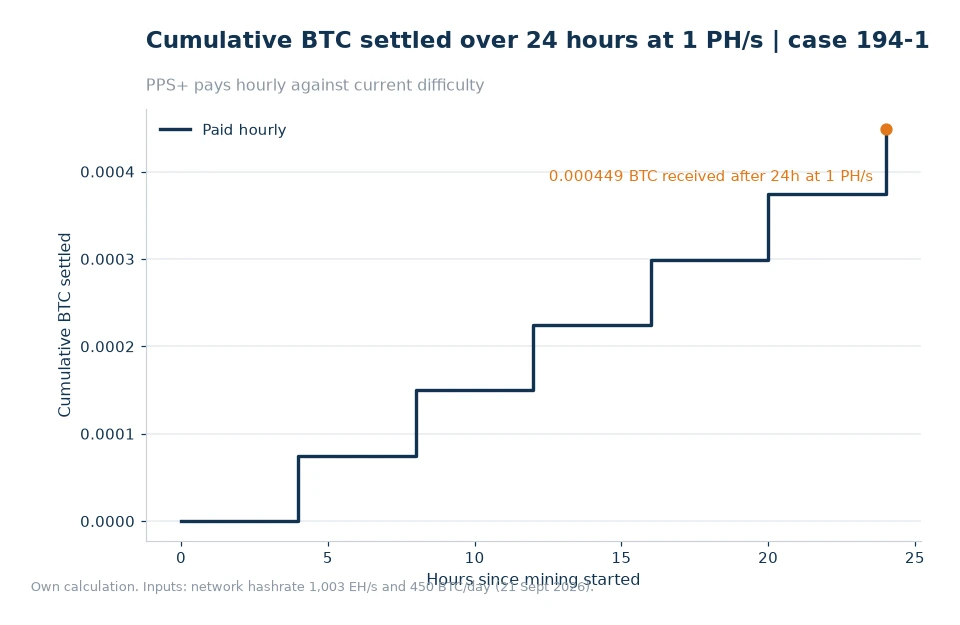
A daily close is the most common report in mining and one of the least informative. At 1 PH/s a full day credits 0.00044861 BTC, worth $37.99 at $84,692 per BTC, and the same figure appears whether the machines ran smoothly or spent the afternoon throttling. What the day can do is divide cleanly into four equal slices, and that is where the useful reading starts.

Key takeaways
- One day at 1 PH/s is 0.00044861 BTC, or $37.99 at the read-date price.
- Each six-hour quarter contributes 0.00011215 BTC, so a weak quarter is 25% of the day.
- The same hashrate at 20 J/TH draws 20 kW, about 480 kWh and $28.80 a day at $0.06.
- A day is too short to judge luck and long enough to judge uptime.
The daily close is a ritual, not a forecast
Every operation has one: the moment someone writes down yesterday's total and decides whether it was good. The ritual is worth keeping because it creates a record, and it is worth distrusting because it invites conclusions the data cannot support. One day of mining is a sample of 24 hourly settlements, which is enough to see a machine that stopped and not enough to see a trend.
The fix is to change what the close is for. Stop asking whether the day was good and start asking whether it matched what the site was configured to do. That question has a right answer, computable in advance, and comparing against it turns a mood into a measurement.
There is a second reason to distrust the daily verdict: the people writing it are usually tired. The close happens at the end of a shift, after ten hours of other work, and the temptation is to glance at the total, compare it with yesterday, and go home. A prepared expectation removes the guesswork from that moment and makes the entry take thirty seconds instead of fifteen minutes.
Why the day is the wrong unit for luck
Under PPS+, the block-reward component is credited hourly against current difficulty, so the day total is largely a function of hashrate and uptime rather than of fortune. That makes the daily figure stable, which is useful, and it also means the daily figure will not warn you about anything gradual. A 2% decline spread over three weeks is invisible in any single day and obvious in a month.
PPLNS accounts have the opposite problem. Their daily total carries real variance from the five-round window, so a good day proves little and a bad day proves less. Judging a PPLNS operation by one day is like judging a season by one afternoon. The right unit there is a week or a difficulty period, and the daily close is only a bookkeeping entry.
Heat arrives before the payout does
The physical day and the financial day do not line up. A rooftop cooling unit works hardest in the afternoon, when ambient temperature peaks, and the machines may throttle for an hour before the room recovers. The credit for that hour is smaller, but it lands in the same daily total as every other hour, so the total looks almost normal while the room was in trouble.
This is why the thermal log and the credit log should be read together. A day that ends at 0.00044861 BTC but contains a two-hour throttle is not a healthy day; it is a day that got away with it. The next hot afternoon may not be so forgiving, particularly if the cooling unit is already near its limit.
Rooftop units also fail slowly. A fan bearing that is starting to seize still moves air, just less of it, and the room runs two degrees warmer every week until one afternoon pushes it over. That is a fault a daily credit total will never show, because two degrees costs a fraction of one percent of hashrate. Only a temperature series catches it, and only if someone plots it.
Read Pool Hashrate at the noon peak
If you check one number at midday, make it Pool Hashrate rather than your own. Your hashrate is what you configured; the pool figure is what the network is doing around you. A pool that grows during a hot week is a pool whose per-block share is shrinking just as your machines are least efficient, and that combination explains a flat credit total better than any hardware theory.
Reading it at the same hour every day also removes a source of noise. Pool Hashrate moves through the day as participants come and go, so a morning reading and an evening reading are not comparable. Pick noon, write it down, and let the series accumulate.
The ViaBTC Mining Statistics page carries the pool figure beside difficulty and the network total, which is the context a daily close needs. Without it, the day's credit is a number with no denominator.
Four equal slices
The most useful property of a 24-hour window at steady hashrate is that it divides into four identical pieces. That makes arithmetic easy and makes a failure easy to localise: a day that is 0.00033645 BTC instead of 0.00044861 BTC has lost exactly one quarter, and the question becomes which six hours went missing.
| Quarter | BTC in the quarter | Value | Share of the day |
|---|---|---|---|
| First, hours 0–6 | 0.00011215 | $9.50 | 25% |
| Second, hours 6–12 | 0.00011215 | $9.50 | 25% |
| Third, hours 12–18 | 0.00011215 | $9.50 | 25% |
| Fourth, hours 18–24 | 0.00011215 | $9.50 | 25% |
Any deviation from four equal rows is a finding. A short third quarter points at the afternoon heat. A short fourth quarter points at a network or power event in the evening. And when all four are slightly low, the cause is upstream of the schedule: difficulty, the pool denominator, or a hashrate that never reached its configured level.
Worked example: a day, quarter by quarter
The arithmetic is short enough to do at the daily close, which is when it is most useful.
- The network mints 144 blocks of 3.125 BTC, which is 450 BTC in total.
- Spread over 1,003 million terahashes, one terahash is worth 0.00000044865 BTC daily.
- A petahash multiplies that by 1,000, giving 0.00044861 BTC.
- One hour is 0.00044861 ÷ 24 = 0.00001869 BTC.
- A six-hour quarter is six of those, 0.00011215 BTC, or $9.50.
- Four quarters make the day, 0.00044861 BTC and $37.99.
- Power: 20 J/TH × 1,000 TH/s = 20 kW, which is 480 kWh a day.
- At $0.06 that is $28.80, leaving $7.67 once the listed 4% is taken too.
Frequently asked questions
Is one day enough to judge a mining setup?
It is enough to judge uptime and configuration, since a clean day at 1 PH/s credits 0.00044861 BTC, but not enough to judge returns, which depend on weeks of power costs and difficulty changes.
Why do my four quarters not match?
Unequal quarters point to conditions rather than arithmetic: afternoon heat, an evening power event or a hashrate dip, because 1 PH/s produces 0.00011215 BTC in any six-hour stretch at steady load.
Should the daily close include the power cost?
Yes, otherwise the number flatters the site; at 20 J/TH and $0.06 per kWh, 1 PH/s spends $28.80 a day on power against $37.99 of gross income.
Close the day, then leave it alone
Record the day, compare it with the four-quarter expectation, and stop. The value of the ritual is the record, not the worrying, and a miner who checks the total forty times a day has the same information as one who checks it once. Use the pool state page for the operational view during the day and the Profit Calculator when a what-if question deserves an answer rather than a guess.
Every number here comes from inputs read 21 Sept 2026 — 1,003 EH/s, 132.76 T, 144 daily blocks at 3.125 BTC, BTC $84,692 — and the ViaBTC fee schedule[1]. The power line uses an assumed 20 J/TH and $0.06 per kWh. Published 24 Oct 2026.