Nano Brewery or Microbrewery First?
If only one step can be financed this year, pick the volume you can sell within a week rather than the volume you hope to sell within a year. Hermann publishes a 200 L nano brewery as the smallest entry in its list, with 300 L and 500 L microbrewery options above it and 1,000 L to 3,000 L vessels above those.
Key takeaways
- Hermann's published list runs from a 200 L nano brewery through 300 L and 500 L microbrewery units to 1,000 L, 2,000 L, 2,500 L and 3,000 L configurations.
- One barrel is about 117 L, so a 500 L batch equals roughly 4.3 BBL and a 1,000 L batch roughly 8.5 BBL.
- A nano kit wins on rent, licensing risk and speed to first sale; a microbrewery wins on cost per litre and shelf presence.
- Cellar space usually binds before brewhouse volume does, so count fermentation tanks before choosing batch size.
The first question is demand, not stainless
Most first projects start with a tank size and work backwards. That order is expensive. The volume decision sets the rent, the staffing, the keg stock and the licensing conversation, and it is much harder to change than a pump or a valve. A better sequence is to estimate weekly sales, convert that into batches per month, and then look for the smallest published vessel that can deliver those batches without running the brewhouse on an unsustainable schedule.
Hermann has been building craft brewing equipment for 23 years and ships to more than seventy countries, so the published list is a reasonable map of what breweries at each stage actually buy. The smallest brewery system in that list is a 200 L nano brewery; above it sit the 300 L and 500 L microbrewery packages, then the larger multi-vessel arrangements.
The same company's larger listings go up to 10,000 L (10 T), which is useful context even for a nano project: it means the supplier has a size ladder you can climb later, with the same tank geometry and the same spares philosophy at every step.
The published size ladder
| Published class | Examples listed | Typical first buyer | Planning note |
|---|---|---|---|
| Nano | 200 L nano brewery | Taproom or restaurant with a small cellar | One or two brews a week; keg stock stays small |
| Small micro | 300 L and 500 L microbrewery | First standalone brewery with local bars | Two to three brews a week fits a single brewer |
| Micro with a dedicated hot side | 500 L 3-vessel brewhouse | Brewery selling to trade and wholesale | Separate vessels allow faster back-to-back brews |
| Mid micro | 1,000 L (2, 3 or 4-vessel) | Established brewery adding a canning run | Vessel count decides how many brews fit a day |
| Upper micro | 2,000 L and 2,500 L 4-vessel | Regional distribution | Cooling and hot water capacity matter more than vessel size |
| Small commercial | 3,000 L and 5,000 L | Multi-site operators | Cellar layout drives the building choice |
What a 200 L to 500 L kit can and cannot do
A nano kit is fast to install and cheap to run in the sense that a small mash is a small mash: less water, less gas, less cleaning chemistry. It also keeps failure survivable, because a batch that does not sell is a week of cash flow rather than a quarter of it. What it cannot do is absorb a sudden order from a supermarket chain, and it gives a brewer very little room for a slow fermentation, because the same tank is expected to be free again next week.
Two restrictions catch people out. The first is the hot side schedule: a single vessel that mashes, lautens and boils is in use for most of a brew day, so two brews a week is realistic while four usually is not. The second is packaging, because small runs mean hand filling or a small canning line, and that labour is what usually decides whether a nano brewery makes money.
Keg handling is the third constraint nobody writes down. A 30 L keg is manageable by hand, a 50 L keg is not for one person on a wet floor, and a cellar full of part-filled kegs is working capital sitting idle. Count how many kegs a batch fills and how many the market returns each week before deciding that a bigger batch is automatically better.
What 1,000 L and above changes
Moving to 1,000 L triples the batch and roughly triples the yield per brew day, which is where cost per litre starts to fall. It also changes the shape of the working week: a 1,000 L brewhouse with two or three vessels can brew on consecutive days, because the mash and the boil happen in different tanks. Hermann lists 1,000 L units in 2, 3 and 4-vessel form, and the 3-vessel brewhouse configurations are the usual answer for a brewery that wants to brew without waiting on its own equipment.
The cost of the step up is not only the hot side. A 1,000 L batch needs roughly twice the fermentation volume of a 500 L batch, and that means more tanks, more floor area, more glycol and a bigger chiller. Counting cellar tanks before signing an order is the single most useful habit for a first-time buyer.
Worked example: cumulative output at 1,000 L per batch
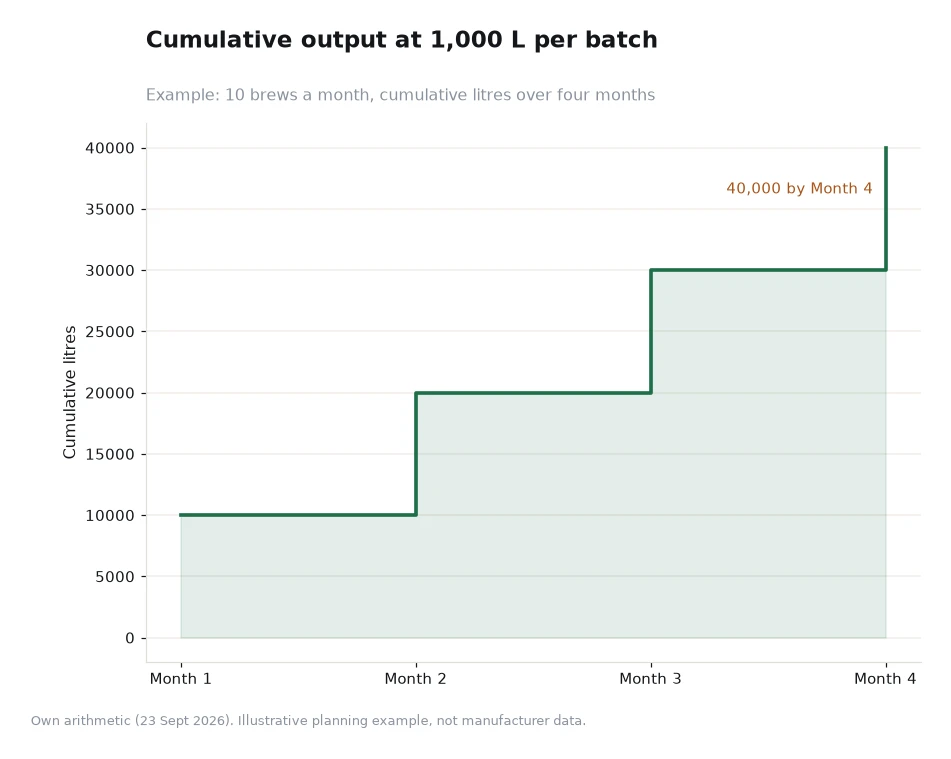
The chart on this page is our own arithmetic, not manufacturer data, and the assumptions are these: a 1,000 L batch, 10 brews a month, losses ignored, and no limit from fermentation capacity. Under those assumptions the brewhouse adds 10,000 L every month. Month 1 closes at 10,000 L, month 2 at 20,000 L, month 3 at 30,000 L and month 4 at 40,000 L. In barrels, 40,000 L divided by 117 L per barrel is about 342 BBL after four months.
Now change one assumption. If the project starts at 500 L per batch and brews 8 times a month, monthly output is 4,000 L and the four-month cumulative total is 16,000 L, which is 40 per cent of the 1,000 L case on the same site. That gap, not the price of the tanks, is the real argument for choosing the larger vessel early when demand supports it: the second-hand value of equipment rarely recovers the cost of upgrading twice.
Frequently asked questions
How much beer does a 200 L nano brewery produce in a year?
At one brew a week, 200 L per brew and 50 brewing weeks, a 200 L kit produces 10,000 L a year, which is about 85 BBL. At two brews a week the same kit produces 20,000 L, or about 171 BBL. Both figures assume no losses from fermentation, transfers or packaging, and no weeks skipped.
Is a 500 L unit worth the extra cost over a 200 L kit?
The decision is about demand rather than price. A 500 L batch brewed once a week for 50 weeks yields 25,000 L a year on the same no-loss assumption, which is 2.5 times the output of a 200 L batch on the same schedule, using the same number of brew days and the same cellar space per tank.
A workable order of decisions
Estimate weekly sales first, then convert them into a batch schedule, then pick the smallest published size that keeps that schedule comfortable. Check cellar capacity next, and only then start comparing options such as vessel count, heating method and the level of control automation. Ask the factory directly through its contact page for the drawings that apply to your building, because floor area and headroom often remove one or two options before price does.
The company overview at 23 years of experience also mentions a business plan service that starts from scratch, which suits first-time buyers who need the numbers to be checked before the tanks are ordered. Whether the answer turns out to be 200 L or 1,000 L, the useful discipline is the same: decide the volume from sales you can name, and keep the equipment decision downstream of that.
Vessel sizes, the 23-year track record and the business plan service described here come from the manufacturer's own website, read 23 Sept 2026; the output figures are our own labelled arithmetic and are not manufacturer data. [1]