Filling looks like the simplest step in fragrance production and it is where most of the visible quality differences are created. The fill route, the way a closure is crimped or torqued, whether assembly runs by hand or on a line, and how the packed unit survives transit together decide whether the bottle that reaches a customer matches the one that was approved. All of it is specification work, not detail work.
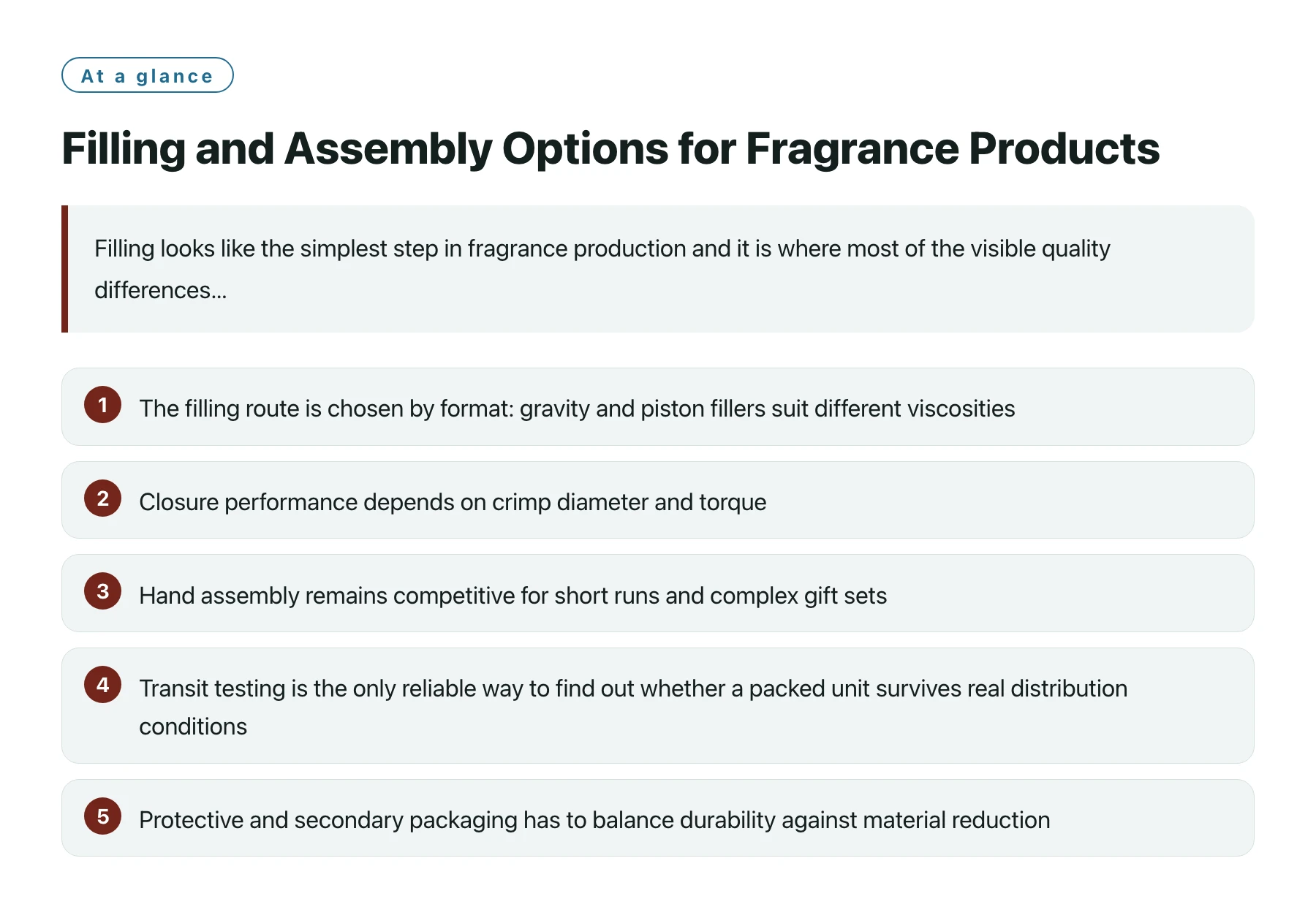
Key takeawaysThe filling route is chosen by format: gravity and piston fillers suit different viscosities, and a mismatch shows up as inconsistent fill levels. · Closure performance depends on crimp diameter and torque, and a leak found in transit is usually an assembly specification problem rather than a bottle defect. · Hand assembly remains competitive for short runs and complex gift sets, but it needs written work instructions to stay consistent between operators. · Transit testing is the only reliable way to find out whether a packed unit survives real distribution conditions, and it is far cheaper than a returned container. · Protective and secondary packaging has to balance durability against material reduction, a trade-off that is documented in packaging sustainability guidance [1].
Most of the attention in a fragrance project goes to the formula, and most of the complaints after launch are about the pack. A bottle arrives with a low fill level, a pump that leaks in a hot warehouse, a cap that has rotated away from the front of the carton, or a set that has shifted inside its insert.
None of those problems are caused by the juice. They are caused by decisions taken in the filling hall and at the assembly table, often without being written down as requirements.
This article covers what the filling step actually includes, how to specify it, and where damage is created long before the parcel is handled by a courier.
What the filling step actually covers
Filling is a sequence: prepare the bulk, rest it, fill to a target weight or volume, fit and close the dispenser, apply the label, code the batch and pack the unit. Each of those steps has a tolerance, and the tolerances together determine whether the output looks consistent on a shelf.
Buyers tend to specify only the first item on that list. The rest is where the inconsistency comes from.
The fill route is chosen by format, not by preference
Different filling technologies suit different liquids and containers. Thin alcohol-based juices flow easily and fill quickly; thicker body mists, oils and gels need different handling. A route that is right for a small rollerball is wrong for a wide-mouth jar.
The practical consequence is that fill accuracy is a property of the match between product and equipment, so the format should be settled before the filling method is quoted.
Closure, crimp and torque are quality decisions
A crimped pump and a screw cap fail in different ways. Crimp depth and diameter determine whether a pump seals against the neck; torque determines whether a screw closure stays tight through temperature change without cracking the collar.
Both are measurable, and both should be written into the filling specification as values with a tolerance, not as an instruction to tighten properly.
How to specify a fill and assembly route
- Settle the format before the filling methodContainer type, neck finish and dispenser decide which filling equipment can be used, so fix them first and quote the line second.
- Write the fill tolerance as a valueState the target fill and the acceptable range in the specification, and confirm how it is checked during the run rather than only at the end.
- Define crimp and torque limitsAsk for the crimp dimensions and closing torque to be recorded, and for samples from the start, middle and end of the run to be retained.
- Decide what is done by handGift sets, ribbons, inserts and multi-piece packs are often assembled manually; ask for the written work instruction and confirm who checks it.
- Run a transit test on the packed unitTest the finished shipper, not the bare bottle. Vibration, drop and compression behaviour of the packed case is what determines whether the product arrives intact.
- Agree the retained sample setKeep approved references from the same batch as the shipment, so a later complaint can be compared against the actual production run rather than against a lab sample.
Fill and assembly routes, and where each one strains
| Route | Best suited to | Where it performs well | Where it strains |
|---|---|---|---|
| Automatic line filling | Long runs of one format | Consistent fill levels and low unit labour | Changeovers cost time, so small or mixed runs suffer |
| Semi-automatic filling | Mid-size runs and several variants | Flexible between formats without a full line reset | Throughput depends on operator pacing |
| Manual filling | Very small runs and trial batches | Low setup cost and easy changeover | Fill consistency varies unless the tolerance is measured |
| Hand assembly of sets | Gift sets and multi-piece packs | Handles irregular components and finishing touches | Needs written instructions to stay consistent across shifts |
| Bulk filling for local packing | Markets with local packing requirements | Reduces freight volume and duty exposure | Shifts assembly quality control to a partner you must audit |
The last row deserves a second look. Shipping bulk and packing near the market can reduce landed cost considerably, and it also moves the final quality check to a third party. If you take that route, the audit you would have run on your own factory has to be run on someone else's — the specification does not travel with the liquid by itself.
Damage in transit is usually blamed on the courier and usually created at the packing table. A bottle that shifts inside its insert will eventually meet a hard surface; a carton that is loaded beyond its compression strength will eventually sit at the bottom of a stack. The inexpensive prevention is a transit test on the packed shipper before the first container leaves, run at the temperature and humidity your market actually experiences. If a test finds a failure, the fix costs a design revision. If the market finds it, the fix costs returns, replacement stock and a retail relationship.
Where assembly quality is quietly lost
Two failures account for most post-launch complaints about fragrance packaging, and both are invisible at the end of the production line because the units look correct when they are packed.
They appear later, which is exactly why they are worth designing against now.
Consistency between operators and shifts
Manual work drifts. The first hundred units of a shift are tighter than the last hundred, and a second operator interprets the same instruction differently. Written work instructions with a photograph of the finished assembly reduce that drift more than supervision does.
Where a measurable value exists, such as closing torque, it should be checked on a sample basis rather than trusted to feel.
Labels, batch codes and shelf life
A label applied slightly off-centre is a cosmetic problem; a batch code that cannot be read is a traceability problem. Both come from the same station and both should be part of the assembly specification.
Ask how the batch code is verified after packing, and confirm that the code on the unit, the carton and the shipping documents can be matched. That chain is what makes a complaint traceable back to a production run.
Manufacturers that offer several filling and assembly routes under one roof tend to present them as one service rather than as separate choices. A house such as the Xuelei fragrance brand, which describes 31 years of fragrance manufacturing in Guangzhou, will usually run automatic, semi-automatic and manual work side by side, and the useful question is which route your format and volume actually justify.
Sources
- Sustainable Packaging Coalition —— A membership organisation working on more sustainable packaging design, publishing material and recyclability guidance.
Frequently asked questions
What is the difference between filling and assembly?
Filling is the step that puts the liquid into the container and closes it. Assembly covers everything after that: fitting the dispenser, applying labels, packing the unit, building gift sets and preparing the shipper. They are often quoted together but they fail in different ways.
How is fill level controlled?
By setting a target fill with an acceptable tolerance and checking it through the run rather than only at the start. Whether the check is by weight or by volume depends on the product, and the method should be agreed in writing before production begins.
Why do pumps leak during shipping?
Usually because the crimp dimensions or the closing torque fall outside the range the component was designed for. Temperature and pressure changes during transport then push liquid past the seal. Retaining samples from the start, middle and end of the run makes this diagnosable.
Is hand assembly acceptable for a commercial launch?
Yes, and for short runs or complex gift sets it is often the better choice. The requirement is documentation: written work instructions, a reference photograph of the correct assembly, and a sampling check so consistency does not depend on which operator is working.
Should I test packaging before the first shipment?
Always. Transit testing on the packed shipper reveals vibration, drop and compression failures that are invisible on a production line. Run it at conditions close to those in your destination market, and fix any failure at design stage rather than after the stock has been distributed.