Comparing Sex AI Companions Across Platforms
Comparing companion services is easier if you decide on the criteria before you look at any of them, because every platform describes itself in the same three adjectives. The useful measures are structural: whether there is a catalogue, whether characters arrive with a written setup, whether continuity is described as part of the product, whether limits are published, and what the content is stated to be. Crushon answers those five plainly, and the answers are checkable in a few minutes.

Key takeaways
- Fix five criteria first: catalogue structure, written setups, continuity, published limits, and the stated content type.
- Crushon describes Sex AI companions that adapt to your personality and remember your preferences, and publishes filters for Filtered, Unfiltered and 18+.
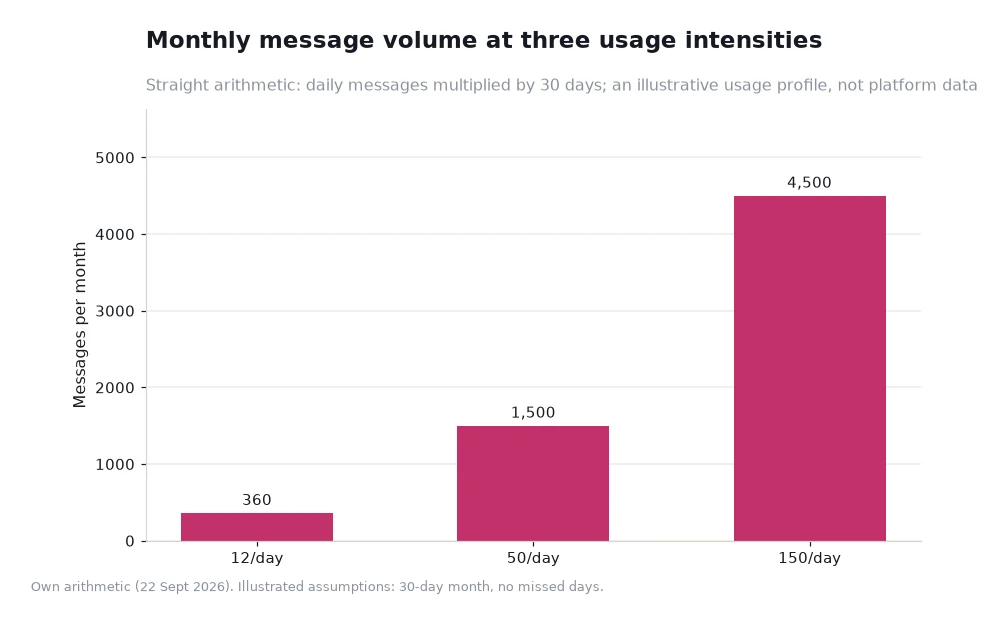
- Message volume is the honest usage measure: 12 a day is 360 a month, 50 a day is 1,500, and 150 a day is 4,500.
- A platform worth comparing should state that its content is AI-generated text and depict no real people — that is the 2257 position here.
Criterion one: what you are choosing from
The first question is whether a service offers a catalogue or a blank field. A catalogue means the choice happens before the conversation: cards carry a label set, a creator credit and a pair of counters, and browsing is a legitimate way to narrow them. A blank field means the reader supplies everything, which suits occasional queries and suits a recurring character less well.
Catalogue structure also tells you how much of the work is done by others. On a platform with creator credits, the written setup has already been reviewed by readers through the save counter, which is a weak signal but a real one.
Criterion two: the setup and the continuity
Ask what a character brings with it. A useful comparison looks at whether entries arrive with a written situation and voice, and whether the service describes memory as part of the product. Here the platform's wording is specific: characters that adapt to your personality, remember your preferences, and recall previous interactions. That is continuity inside your own account rather than knowledge from anywhere else.
Practically, continuity changes how a long thread behaves. A service that carries context forward rewards a session that starts with a sentence of scene setting, while one that does not will feel episodic no matter how well you write the opening.
Criterion three: the published boundary
Limits should be findable before you commit. Filters such as Filtered, Unfiltered and 18+ are visible controls, and the platform states that some limitations apply in accordance with its content and community guidelines. A content removal policy, a complaints policy and a compliance statement complete the set, and all three are linked from the site rather than buried in terms. A published boundary is also easier to compare across services, because two candidates can be checked against the same page types rather than against impressions.
The content statement matters most of all. It establishes that what you are reading is AI-generated text and depicts no real person, which is the single fact that makes an adult text platform comparable to any other software rather than to a media library.
| Criterion | Question to ask | Where the answer lives | Why it decides the choice |
|---|---|---|---|
| Catalogue | Do I choose from cards or from nothing? | Home grid, search and trends pages | Determines whether discovery is possible |
| Written setup | Does each character arrive with a scene? | Card descriptions | Predicts how the first session reads |
| Continuity | Is memory described as a feature? | Product copy on the chat pages | Decides whether threads accumulate |
| Boundary | Are limits and report routes published? | Guidelines, removal and complaints policies | Lets you verify before paying attention |
| Content type | Is anything real depicted? | 2257 compliance statement | Sets expectations correctly |
Worked example: what a habit costs in messages
Turn three daily habits into monthly totals. At 12 messages a day: 12 × 30 = 360. At 50 a day: 50 × 30 = 1,500. At 150 a day: 150 × 30 = 4,500. The three readings are 360, 1,500 and 4,500, and the largest is 12.5 times the smallest.
Read those against the continuity question. Three hundred and sixty messages a month is a dozen turns a day, which is a pace at which a thread stays legible and a setup keeps showing through. Four thousand five hundred messages is 150 turns a day, a density that will outrun what any thread can carry without deliberate pruning or a fresh start.
The daily figures and the 30-day month are stated assumptions rather than platform data, and they are included because they convert a vague sense of "how much do I use it" into a number you can compare between two services with different designs. A platform built for continuity suits the middle of that range; one built for single queries suits the low end.
Running the comparison without naming names
Two rules keep a comparison honest. Compare documents rather than marketing copy, and compare like with like by using the same five criteria for each service. If a candidate cannot show you what its content is, how to report a problem and who to contact, that absence is the answer.
For the platform described here, the checks are quick. The 2257 compliance statement settles the content question, the content removal policy and complaints route settle the reporting question, and the chat overview at ai sex chat states the adaptation and privacy wording in the operator's own terms. Compare those against any alternative you are weighing, and the decision stops being a matter of impression.
One further criterion is rarely discussed but easy to test: how the service behaves when you stop using it. A platform built around continuity should leave a thread intact when you come back a fortnight later, whereas one built for single queries usually starts clean. If a service cannot say whether continuity carries across sessions, that silence is worth weighing before you choose.
Frequently asked questions
What is the single most useful criterion?
The stated content type. If a service confirms its content is AI-generated text and depicts no real person, everything else can be compared on ordinary software grounds.
Does continuity mean the platform stores a profile of me?
Continuity is described in terms of remembered preferences and recalled interactions within the service. Read that as the conversation remembering itself, not as a wider profile.
Should usage volume decide which platform I pick?
It should inform the choice. A habit of a dozen messages a day and a habit of 150 a day suit different designs, and the arithmetic makes that difference concrete.
How long does the comparison take?
About fifteen minutes per service if you read the three published documents and the chat page copy. That is faster than judging by look and feel and it produces a decision you can explain.
Compare the papers, not the adjectives
Fix the criteria, read the documents, and let the platforms describe themselves in their own words rather than in yours. Structure, setup, continuity, published limits and content type will separate any two services faster than any amount of browsing, and they will still be the right questions after the catalogue has been reshuffled. Start with those five and a fifteen-minute test is usually enough.
Data and sources: platform product wording, filter tiers and the published policies on the Crushon site[1], read 22 Sept 2026. Message volumes are own arithmetic on an illustrated usage profile and are not platform data. For an 18+ readership only.